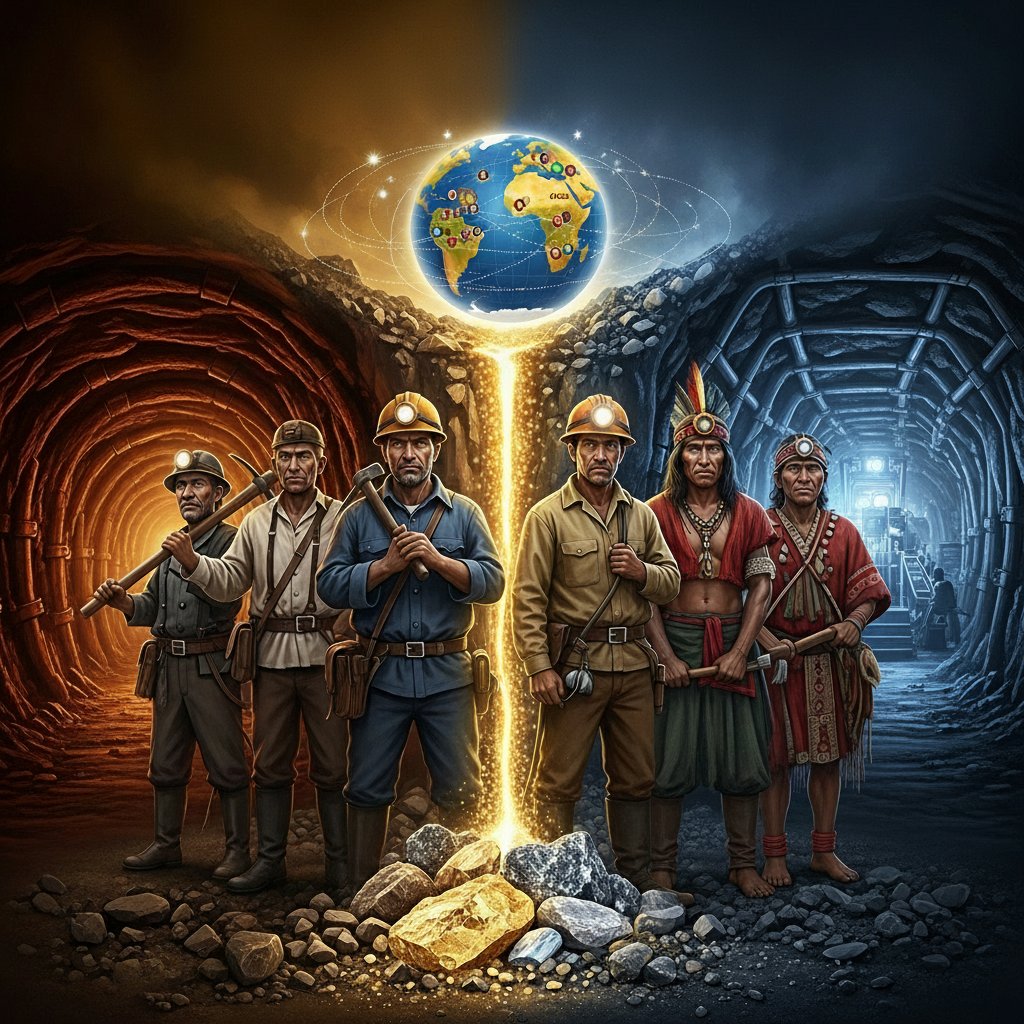
In the Andes, the Inca mit’a system organized labor for the common good, creating a fair and structured way for communities to contribute. When the Spanish arrived, they corrupted this system into forced labor for the Conquistadores, exploiting miners while amassing enormous wealth. This contrast between equitable and oppressive systems illustrates that mining has always mirrored the values and ethics of society.
Mining has never been just about rocks and metals, it has always been about people. From ancient labor systems to modern environmental and social movements, the story of mining reflects the lives, struggles, and ingenuity of those who work to uncover the Earth’s treasures.
Over time, miners fought for safer working conditions, fair compensation, and respect for their labor. The Industrial Revolution, while introducing technological advances, also highlighted dangerous working environments and environmental degradation. Tools like dialectical and historical materialism help us understand the interconnectedness of labor, resources, and society, showing how mining is both a technical and social enterprise.
Environmental awareness has also become a crucial part of mining. From polluted rivers near old mines to sustainable practices in modern operations, the relationship between humans and the Earth demands balance. Today, engineers and geologists combine lessons from history with modern science to minimize harm while extracting resources responsibly.
This narrative shows how mining has always been deeply connected to people and the structures that govern them. However, Modern practices must navigate these human realities, making ethical responsibility just as essential as technological advancement.
Mining reflects humanity itself: creativity, perseverance, mistakes, and adaptation. By studying its history, from the Inca mit’a to contemporary labor and environmental movements, we gain a deeper appreciation for the courage and resilience of those who shape the Earth and are shaped by it. Mining is as much a human story as it is a geological one.
Sean Daly is a geologist, mining engineer, and environmental advocate whose lifelong passion for Earth’s resources was shaped by his coastal upbringing in British Columbia. His work bridges ancient mining wisdom with modern geological science, offering a unique perspective rooted in both field experience and historical curiosity. Through global exploration and hands-on expertise, he brings the story of mining’s evolution vividly to life.
The transition from the Inca mit’a system to Spanish forced labor offers a powerful case study in the ethical duality of resource extraction. The discussion extends into modern times, examining how labor rights, environmental concerns, and social justice movements continue to influence mining practices, encouraging us to see mining as a social ecosystem where workers, communities, and landscapes are deeply intertwined.